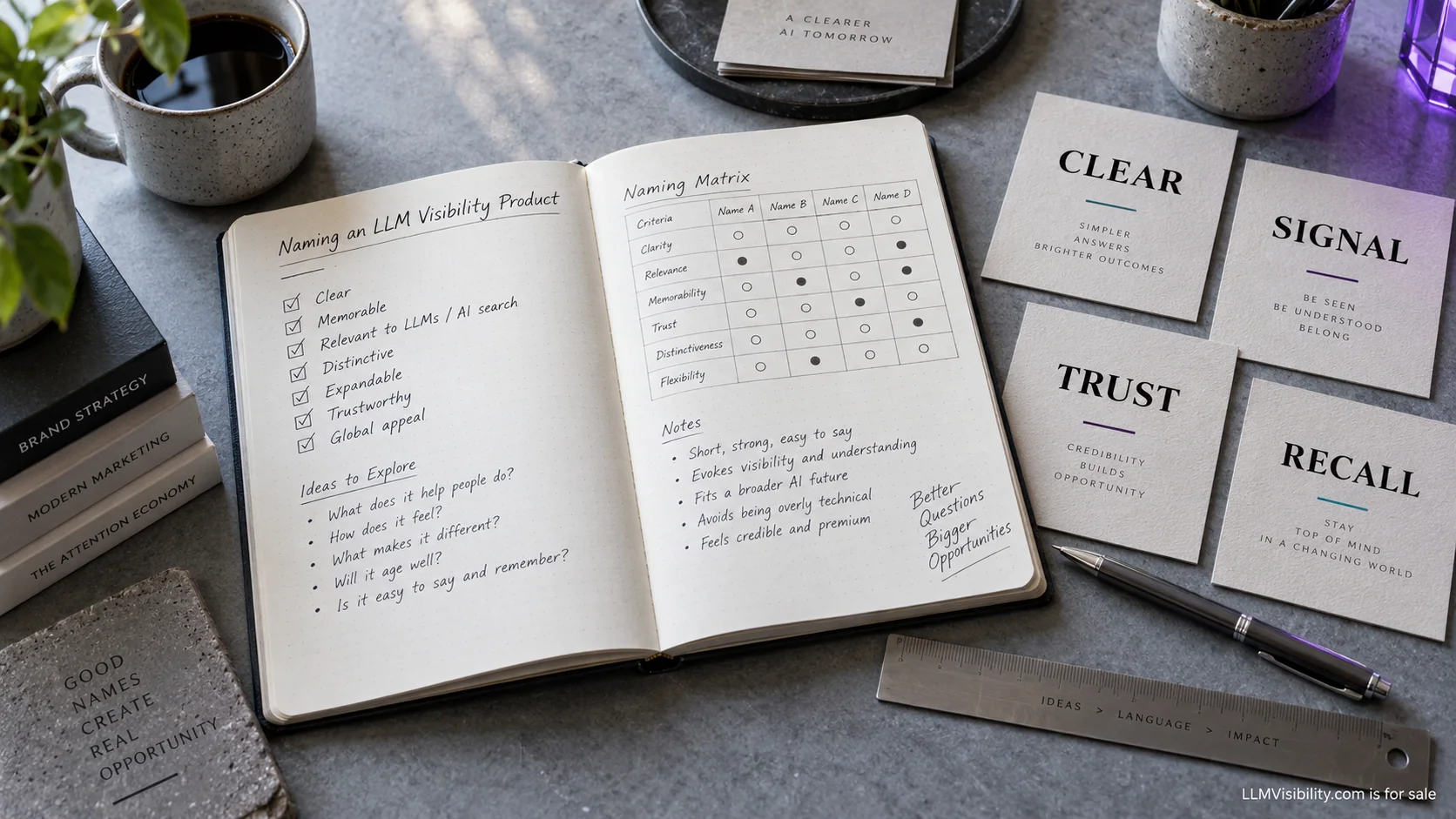
A name creates an expectation before the demo
A prospective customer encounters a product name in an email, a conversation, or a search result. Before reading the feature list, that person starts forming an idea of what the product concerns. A category name can make that first impression easier to understand, especially when the buyer already knows the problem being discussed.
LLM visibility is a useful example. The words suggest a concern with presence in answers from large language models. They do not specify whether the product collects citations, manages factual corrections, reviews content, or supports agency reporting. The product description has to supply that detail.
The naming task is therefore partly an exercise in setting expectations. A founder needs a name that fits the subject and a supporting explanation that describes the actual capability. Those two parts should work together from the first landing page through the customer’s ordinary use of the product.
Write the product’s smallest honest promise
Before comparing names, write one sentence describing the job the first release performs. Identify the customer, the action, and the evidence the product returns. For example: “Marketing teams can review saved answers and citations across an approved set of buyer questions.”
That sentence gives the naming discussion a stable reference. It makes clear that the product is a review and monitoring tool with a defined sample. If a proposed headline implies influence over every answer system, the mismatch becomes visible before the team invests in a full identity.
The sentence should be specific enough to guide a demonstration. A customer should be able to watch the product perform the described job and inspect the result. A phrase that sounds attractive but cannot be demonstrated needs more definition before it becomes the central promise.
Distinguish the company, the product, and the feature
A house name identifies the organization or family of offerings. A product name identifies a particular service. A feature name identifies a task inside that service. A single phrase can sometimes serve more than one role, but the team should make that choice deliberately.
A broad category domain such as LLMVisibility.com could be the main home for a focused product or for several related offerings over time. The first release would still benefit from a subtitle that narrows its purpose. A customer should not have to infer the current feature set from the size of the category.
Inside the product, straightforward labels can reduce confusion. “Citation history” tells a user what a view contains. “Answer review” describes an activity. A dramatic feature name may require an extra explanation every time the user opens it, which can weaken the clarity gained from the main brand.
Use a matrix to expose the tradeoffs
| Naming level | The question it should answer | An illustrative description |
|---|---|---|
| House | What subject connects the business? | LLM visibility and AI-search presence |
| Product | What job does this offering perform? | Citation monitoring for approved buyer questions |
| Feature | What can the user do here? | Review answer history and source links |
| Report | What evidence is being summarized? | Citations observed during the selected period |
The matrix helps a team spot language that belongs at the wrong level. A broad category phrase may work well as the house identity while being too vague for a button. A highly specific feature phrase may explain a task beautifully while limiting the public name of a business that expects to add related products.
It also helps with expansion. If a company later adds a content review tool, the team can decide whether it belongs under the same house identity and how to distinguish it from the monitor. The naming structure becomes a practical way to organize customer expectations.
Inspect the verbs as closely as the name
Claims often become excessive through verbs. “Records,” “compares,” “flags,” and “exports” describe actions a product may be able to perform directly. “Dominates,” “guarantees,” or “controls” can imply outcomes beyond the product’s actual reach.
The right verb depends on the capability. If a tool saves visible citations from collected answers, say so. If it suggests edits for human review, describe those as suggestions. If it reports a sample, keep the sample visible in the explanation instead of presenting the output as a complete account of the market.
A useful review exercise is to underline every verb on the homepage. Ask a product specialist to show the feature that supports each one. Where the evidence is missing, revise the statement or narrow the scope. This creates a direct connection between marketing language and the customer’s experience.
Test comprehension with the intended buyer
Show the name and one-sentence description to someone who resembles the intended customer. Ask what they believe the product does, what information they expect to provide, and what result they expect to receive. Let them explain before showing the feature list.
The goal is to discover mismatches. A buyer might assume that “visibility” means website traffic, while the product reports answer citations. Another might assume that a “suite” includes publishing capabilities when it only creates review tasks. Those reactions help the team improve the supporting language.
Avoid treating a preference vote as a complete naming test. A person may like a name while misunderstanding the offering. The more useful evidence is whether the name and description lead the intended customer toward an accurate expectation of the product.
Leave room for growth without hiding the first release
Founders often want a name that can accommodate future plans. That is reasonable, but the current product still needs a concrete explanation. A broad domain can hold a narrow launch if the page clearly states what customers can use today.
The roadmap belongs in its own context. A feature being considered should not appear in the same list as an available capability without a clear distinction. A potential enterprise workflow should not make a small initial tool sound as though it already handles complex permissions or approval requirements.
One practical approach is to keep the main description tied to the current job and use a separate paragraph for the direction of development. That gives buyers an accurate basis for evaluation while leaving the business free to evolve.
Treat availability and suitability as separate checks
A domain acquisition addresses control of a web address. A business still needs to evaluate whether the intended name suits its audience, markets, and product plans. It should also arrange appropriate professional review of trademark questions before making commitments around a brand.
A naming workshop cannot provide legal clearance, and a descriptive phrase should not be treated as a substitute for that review. The operational task is to document the intended use and candidate identity clearly enough that the appropriate adviser can assess it.
The same care applies to social handles, existing company names, and the way a brand will be spoken aloud. These are practical considerations for the intended business. They should be checked as part of a deliberate naming decision rather than assumed from the availability of a domain.
Rewrite one vague claim today
Take a sentence such as “Get complete AI visibility” and ask what the customer actually receives. A more specific alternative might be “Review mentions and source links in answers collected for your approved question set.” The revised line tells the reader what the product does and where its evidence begins.
Then place that sentence beneath the proposed name. If the pair is clear, the identity has a stronger foundation. If the explanation still feels evasive, the product scope may need another pass. The four concept pages show different jobs that could fit LLMVisibility.com. A buyer considering the domain can use the same exercise to describe an intended product in a private inquiry.