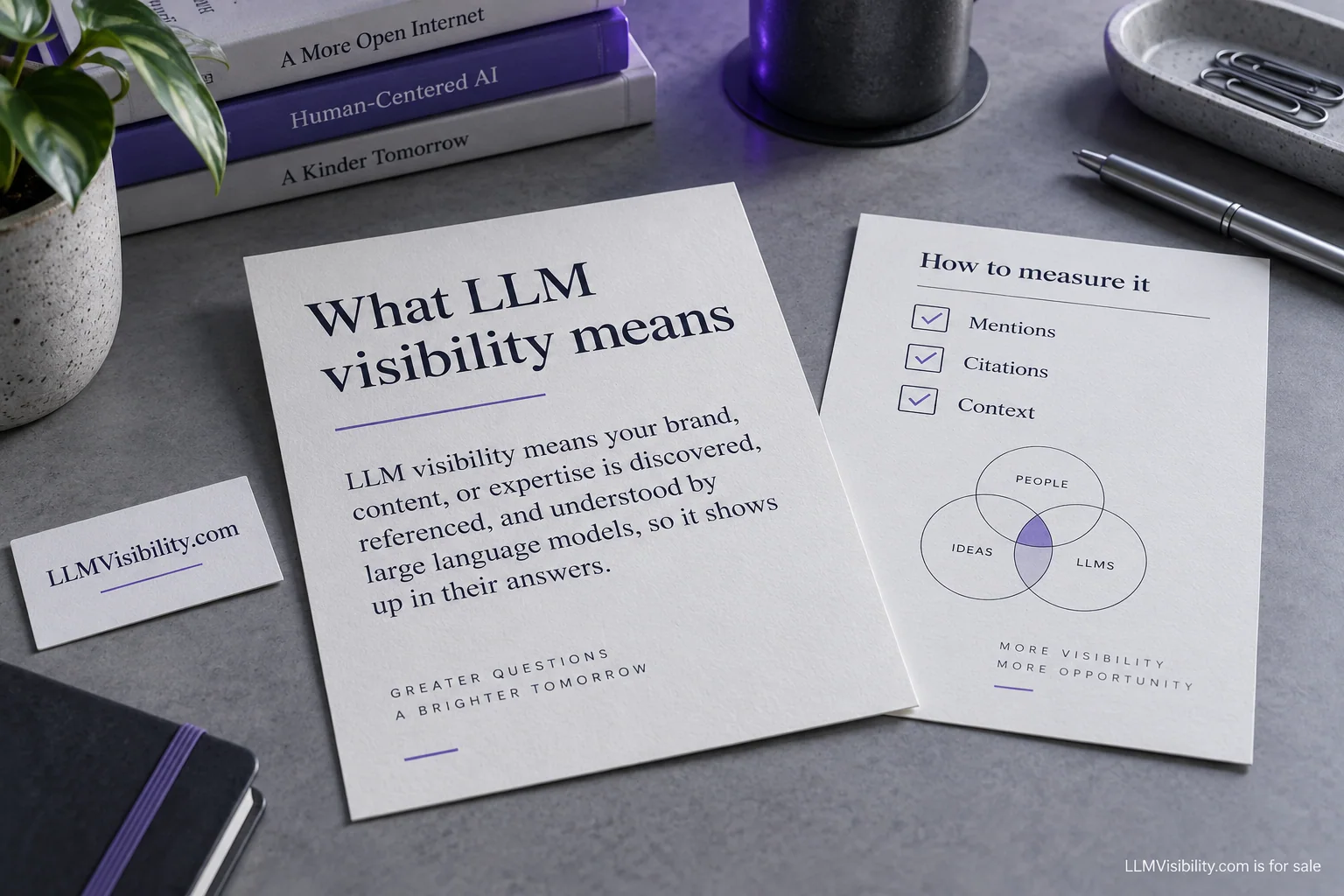
Define the observation before naming the result
LLM visibility is a useful label for how a brand, page, or body of information appears in answers produced by a large language model. The label becomes meaningful when it is attached to a specific observation: a question was asked, an answer was returned, and a particular name or source appeared under recorded conditions. Without that context, “visibility” can cover several different things that a team may care about for different reasons.
Consider an illustrative question from someone evaluating scheduling software for a small field service business. An answer might mention several products, explain common selection criteria, and link to a guide published by a software company. The company that published the guide has received a citation. That does not necessarily mean its software was recommended. Another company might be recommended without a link to its own website.
A useful definition therefore starts with what can be observed. It gives the team a shared language for describing an answer before anyone turns it into a chart or a claim about market position.
A mention, a citation, and a recommendation do different jobs
A mention occurs when the answer names the relevant entity. Reviewers need to check that the name refers to the intended company or product. Common words, abbreviations, renamed businesses, and similarly named companies can make that less obvious than it first appears.
A citation is a visible reference to a source. For practical monitoring, that often means a link attached to the answer. The source may be a page owned by the brand, a third-party article about it, or material unrelated to the brand’s own product. Recording the destination matters because the link reveals what the answer presents as supporting material.
A recommendation expresses suitability for a particular need. It has context: the answer may recommend a product for a limited use case or include a qualification that changes its meaning. A reviewer should preserve those words rather than reducing every favorable mention to the same label.
These categories can overlap. An answer may mention a business, recommend its product, and cite its documentation in one paragraph. Recording each part separately helps a marketer understand what actually happened and what kind of follow-up might be useful.
Presence belongs to a question and a setting
A brand can appear in an answer to one question and be absent from a closely related question. The wording may include a location, a budget constraint, a business size, or a particular task. Those details affect what counts as a relevant answer. They should therefore remain attached to the observation.
The collection setting matters too. A team should record the surface used, the date, the locale, and the method of access. If the interface identifies a model or mode, record that information as well. If it does not, mark it as unavailable instead of filling the gap with an assumption.
Repeated observations can reveal variation, but they need to be collected deliberately. A person who keeps rerunning a question until a preferred answer appears has learned that the answer is possible. They have not established how often a typical customer will encounter it.
This is why a visibility statement should include its scope. “The brand appeared in these collected answers during this review period” is a claim a team can inspect. A statement about what every buyer sees requires evidence that a small monitoring exercise usually does not provide.
How this differs from a familiar ranking report
A conventional ranking report often centers on the position of a page for a query under defined conditions. An answer review has more dimensions. The company might appear in the text, receive a link in a source panel, or be discussed only as an alternative with a specific limitation. A single position number can conceal those distinctions.
There is also a difference between the object being measured and the business outcome. A citation is an observable reference. A visit is a recorded arrival at the website. An inquiry or purchase is a later action. Teams should avoid treating these as interchangeable events, even when they hope one will lead to another.
For Google’s own AI search features, the company says established SEO practices remain relevant and that no additional technical requirements apply beyond the stated eligibility rules. That is a useful reminder to inspect the underlying content and access conditions alongside answer observations. See Google Search Central’s guidance on AI features.
Build a small question set around a real buyer job
Start with the decision the intended reader is trying to make. A buyer comparing tools may ask about compatibility, implementation effort, or the tradeoffs between approaches. A user who already owns a product may need a troubleshooting answer. Mixing all of those questions without labels makes a summary difficult to interpret.
For a first review, choose one buyer job and write a small group of questions that naturally belong to it. Note where the language came from, such as customer conversations, support tickets, or approved market research. Questions invented by the marketing team can still be useful for exploration, but they should be identified as hypotheses.
Separate questions that name the brand from questions that leave the choice open. Asking what a named product does tests a different kind of presence from asking which products suit a particular task. Both may matter, but they answer different questions about discovery and understanding.
Keep a record another person can review
A simple evidence sheet can be enough for an initial audit. Include the exact question, collection date, surface, response, visible source links, and a short classification. Add a note for ambiguous cases and a field indicating whether a human has reviewed the record.
Preserve incomplete attempts as well. If an answer could not be collected or a page failed to load, the gap should remain visible. Otherwise, the final report may look more complete than the collection actually was.
The reviewer should be able to move from a summary to the underlying answer. That makes disagreement productive. Two people can inspect whether a passage is a recommendation or merely a mention, then improve the classification rule for future observations.
Interpret the result with the next action in mind
An answer review is most useful when it helps someone decide what to inspect or improve. An outdated feature description could lead to a documentation review. Repeated references to an external guide could prompt an investigation of why that guide addresses the buyer’s question effectively. A missing brand mention might justify more sampling before any content work begins.
The observation alone does not explain its cause. A later change in an answer could coincide with a website update, a source change, or a different collection setting. A careful report keeps the timeline and evidence visible while treating causal explanations as hypotheses to investigate.
That approach also makes a quiet result useful. A stable set of accurate answers may require no immediate intervention. The team can retain the baseline and spend its attention elsewhere.
Try one bounded audit
Choose one brand question that matters to a real customer. Record the wording and the reason for selecting it. Collect an answer through a clearly identified surface, save the visible evidence, and mark mentions, citations, and recommendations separately. Ask a colleague to review the classification.
Then write three sentences: what appeared, what the observation does not resolve, and what action is justified next. That short note is a practical starting point for a larger measurement program. The companion guide on measuring AI citations explains how to develop the sample and reporting rules. For a possible product built around this work, explore the GEO monitoring concept.