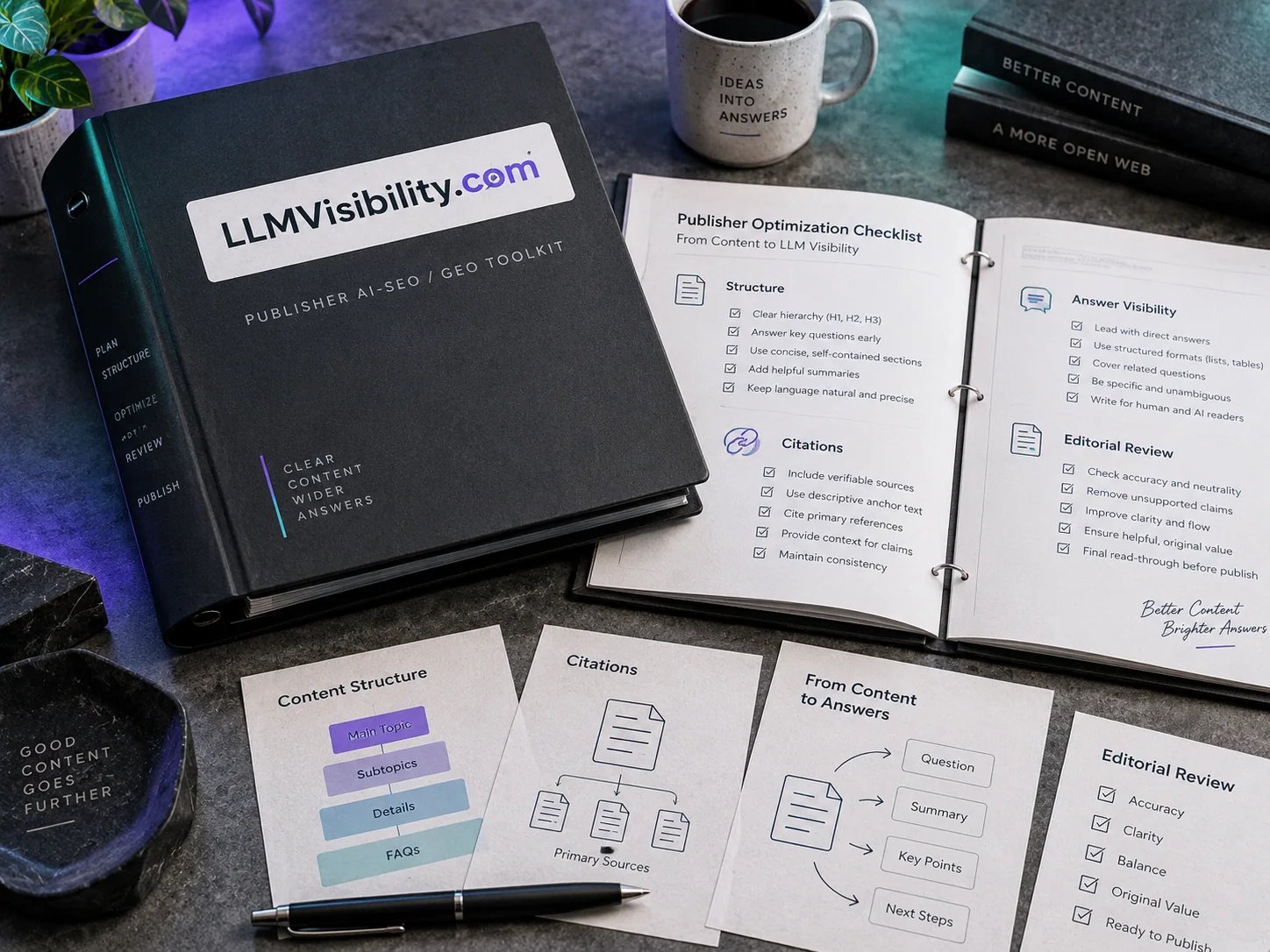
Start at the editor’s desk
A publisher has useful reporting, experienced contributors, and an archive that keeps growing. An editor wants to know whether important facts remain current and whether readers can find the evidence behind them. Questions about AI citations add another reason to inspect that material carefully. LLMVisibility.com could name a toolkit that helps editorial teams perform that review.
The initial audience might be a specialist publisher producing explainers, research summaries, or buying guides. Its value depends on original expertise and clear sourcing. A toolkit for that audience would need to respect editorial judgment, make review tasks specific, and fit the publication’s existing standards.
The concept would focus on the quality and maintenance of source material. Citation observations could help editors identify questions to investigate, while publication decisions would remain with the people responsible for the content.
Turn an article review into a useful checklist
A review could begin with the reader’s question. Does the article answer it early enough to orient someone arriving from a link? Are important terms defined in language the intended reader understands? Does a factual claim have a traceable source, and can the reader tell when that source was published?
The next pass would examine scope. An article about a particular market should say which market it covers. A comparison should explain its criteria. A research summary should distinguish the study’s findings from the writer’s interpretation. Those details make the material easier to assess and maintain.
The final pass would check ownership and freshness. The toolkit could ask for a responsible editor, a review date, and the conditions that should trigger an update. A page about a stable concept may need little intervention, while an article describing changing product features could need a more frequent review cycle.
Preserve the publication’s evidence
A source register could connect claims to the documents, interviews, or datasets that support them. For each source, an editor might retain a title, publisher, date, link, and a note describing the claim it supports. The register would make it easier to revisit an article when a link breaks or a source changes.
Original reporting needs particular care. A quotation should remain attached to its speaker and context. A number should carry its unit, period, and denominator where relevant. If an article combines several sources, the reader should be able to tell which one supports a particular conclusion.
The toolkit could help flag missing context, but a flag would be a request for review. An editor might reasonably decide that a passage already explains enough for its audience. Recording that decision would keep the tool from turning the same editorial choice into a repeated warning.
Use citation observations as a research input
A publisher could maintain a small set of questions related to its strongest coverage areas. Periodic observations might show which pages are linked in answers, how those pages are described, and which outside sources appear alongside them. An editor could use those records to investigate gaps or misunderstandings.
For example, a detailed explainer may be cited for a narrow definition while its original research receives little attention in the sampled answers. That finding could prompt a review of the research section’s clarity and context. It would not establish that a particular rewrite will lead to more citations.
The toolkit should keep the observation and the editorial decision together. A note could explain that a paragraph was revised because readers needed a clearer definition, with a citation observation serving as one input. That record would remain useful even if later answers changed for unrelated reasons.
Connect the toolkit to existing publishing work
The first integration could be modest. Editors could import an article URL, complete a review, and export tasks to their existing planning system. The toolkit would provide a source register and a maintenance queue without requiring the publication to replace its content management system.
A later version might compare revisions or group articles by topic. The product would need to preserve author attribution and approval responsibilities. It should also make it easy to distinguish a proposed edit from an approved one, especially when several people review the same article.
The first customer evaluation could use a small collection of evergreen articles with known maintenance needs. Editors would assess whether the toolkit finds meaningful issues, helps them locate supporting material, and reduces the effort required to prepare an update. The evaluation would also reveal which flags create unnecessary work.
Keep success connected to editorial value
A useful toolkit could measure completed reviews, resolved source problems, and the time between an important change and a published correction. These measures describe work the publication can inspect. Referral traffic and observed citations could sit beside them with the appropriate scope and caveats.
The product should make no promise that a revised article will appear in a particular answer. Its credible value would be a more organized editorial process and a clearer body of source material. A publisher could evaluate that value through its own standards, audience feedback, and maintenance needs.
A founder would also need to decide which content types the first release supports. An interview, a statistical report, and a product comparison have different review requirements. Choosing one or two formats would make the initial checklist more useful than a universal score applied to every page.
Consider the name in the wider product family
LLMVisibility.com could give this toolkit a recognizable category home. A descriptive product line would make the editorial focus explicit, such as “Source review and citation evidence for publishing teams.” The name could accommodate additional research features as customer needs become clearer.
Before pursuing this direction, compare the GEO monitor and agency desk. The publisher concept centers on an editor’s responsibility for source material; the other concepts organize different jobs. If that editorial focus fits the intended business, inquire about acquiring LLMVisibility.com with the publication type and first workflow in mind.